Dr Fuhrman discusses a study showing a strong correlation between midlife fitness and greatly lower probability of late life dementia.
https://www.drfuhrman.com/library/eat-to-live-blog/156/heart-brain-connection-fitness-now-protects-your-brain-in-your-70s-and-80s?utm_campaign=Nutritarian%20Diet&utm_source=hs_email&utm_medium=email&utm_content=62963926&_hsenc=p2ANqtz-9soQo4BfroKThedGmHNBvBDwtp8lPMjVaDjTfF903K8oB051Dgrf9J2m9jcY-AdiYaufrrxbFViFWB_BhvD50xhZoHOg&_hsmi=62963926
Wednesday, May 16, 2018

Tuesday, May 15, 2018
Breaking a Fast
Fasting is a complex topic. The most basic thing we could say about fasting is "don't eat till you're hungry". The primary mechanism of fasting is to give the digestive system a rest. Digestion requires a lot of energy, which is why when we "eat heavy" we can suddenly get sleepy and tired. So much energy is diverted to the work of digestion the body begins to conserve energy in other ways, and just wants to go to sleep.
Sleep and fasting are related activities. When I was a kid I used to wish I never had to sleep, it seemed a big waste of time. But we know what happens when we don't sleep, we get dingy. Staying awake indefinitely is not possible, the body will just lose consciousness at some point. Before that point is reached we will begin to hallucinate because our body is no longer being cleared of toxins as quickly as they are built up. These toxins flood our brain in a process called "autointoxication", or self-poisoning resulting from retention of the waste products of metabolism. Experiments with lab animals kept awake ends in death...these toxins are real.
So yep sleep is a good thing, and so is fasting. We do it every night, and end that fast with "break fast". It's like a miracle cure to rid ourselves of toxins faster than we produce them. And we never stop producing them, cells regenerate continuously, and the die-off has to go somewhere.
There are a couple of things we can do that increase our health and vitality quickly. One is to get plenty of sleep (it's better to sleep without an alarm if possible), and the other is to extend the nightly period of fasting. We can do that in two ways: one by not eating anything a few hours before bed, and the other to wait for the first meal of the day. Or both.
Skipping breakfast is probably the easiest way to do "intermittent fasting", and once we become accustomed, it's not difficult. Drinking as much water as desired in that period helps to become accustomed.
If we have that "jittery feeling" when we don't eat, it's telling us something...we are experiencing abnormally large blood sugar swings caused by the condition called "insulin resistance", which occurs when we introduce carbohydrates into a diet high in animal products and fats. Did you know for example that eggs are 35.5% protein, 2.6% carbs, but 61.9% fat (cronometer.com)? One of the primary benefits of a whole foods plant based diet can be an end to insulin resistance (and the tyranny of ravenous hunger).
Fasting also affords another healthful opportunity, which is to "reprogram" our taste buds to better food choices. If we wait to eat until we're hungry, almost anything we eat tastes better. My first meal of the day is typically about noon (second one is veggies for dinner), and frequently looks something like this: half a papaya, half a pineapple, one orange, one pear and about half a cup blueberries.
 Or this: half cantaloupe, two pears, two bananas and a half cup blueberries.

It's hard to miss with fruit, and you know what? I've even come to the point I think it tastes better than croissants, bacon and eggs. It sure is easier to digest!
Sleep and fasting are related activities. When I was a kid I used to wish I never had to sleep, it seemed a big waste of time. But we know what happens when we don't sleep, we get dingy. Staying awake indefinitely is not possible, the body will just lose consciousness at some point. Before that point is reached we will begin to hallucinate because our body is no longer being cleared of toxins as quickly as they are built up. These toxins flood our brain in a process called "autointoxication", or self-poisoning resulting from retention of the waste products of metabolism. Experiments with lab animals kept awake ends in death...these toxins are real.
So yep sleep is a good thing, and so is fasting. We do it every night, and end that fast with "break fast". It's like a miracle cure to rid ourselves of toxins faster than we produce them. And we never stop producing them, cells regenerate continuously, and the die-off has to go somewhere.
There are a couple of things we can do that increase our health and vitality quickly. One is to get plenty of sleep (it's better to sleep without an alarm if possible), and the other is to extend the nightly period of fasting. We can do that in two ways: one by not eating anything a few hours before bed, and the other to wait for the first meal of the day. Or both.
Skipping breakfast is probably the easiest way to do "intermittent fasting", and once we become accustomed, it's not difficult. Drinking as much water as desired in that period helps to become accustomed.
If we have that "jittery feeling" when we don't eat, it's telling us something...we are experiencing abnormally large blood sugar swings caused by the condition called "insulin resistance", which occurs when we introduce carbohydrates into a diet high in animal products and fats. Did you know for example that eggs are 35.5% protein, 2.6% carbs, but 61.9% fat (cronometer.com)? One of the primary benefits of a whole foods plant based diet can be an end to insulin resistance (and the tyranny of ravenous hunger).
Fasting also affords another healthful opportunity, which is to "reprogram" our taste buds to better food choices. If we wait to eat until we're hungry, almost anything we eat tastes better. My first meal of the day is typically about noon (second one is veggies for dinner), and frequently looks something like this: half a papaya, half a pineapple, one orange, one pear and about half a cup blueberries.

It's hard to miss with fruit, and you know what? I've even come to the point I think it tastes better than croissants, bacon and eggs. It sure is easier to digest!
Friday, May 11, 2018
Water Only Fasting...where are we and why are we here?
I was explaining to a friend why water only fasting is the most powerful healing modality we have by some exponential function. It goes something like this:
We need calories as fuel. We need nutrients to repair and maintain our body. An analogy might be we need gas for our cars to run, but if they are in need of repair and maintenance we won't get to where we are going in a timely manner or at all. And more gas won't help that situation a single bit.
In water only fasting we discontinue all consumption of calories and nutrition for the duration. How does that help? Our bodies are self healing mechanisms, with enough "fuel" on board to last us quite a while. So the body begins drawing on the fuel reserve for energy, but it does not do so indiscriminately. It begins by breaking down and consuming "least important" (in terms of healthy functioning) parts of the body. It begins by consuming the "dispensables", and conserving the "indispensables" we need for health and survival.
Pathogenic tissues just happen to be on the top of the dispensables list. This is a key part of "body intelligence", which is the basic way of thinking of the body's self healing mechanisms which are complex and always ongoing. We can watch it work on the surface when we, for example, cut a finger in the kitchen, but most of this self healing mechanism works on the interior, and we don't see it as directly. But we certainly experience it as makes us feel stronger and better.
So when we water fast the body begins consuming the pathogenic tissues first and most rapidly. Now if you really don't trust body intelligence completely you are not alone, we have been conditioned to trust medical intervention above body intelligence. I have come to understand this "problem" (because it is a problem) as a basic misunderstanding of "where we are", which is "in nature", as opposed to a technological construct, which is also true, but to a much lesser degree.
This misunderstanding is in essence a partial misapprehension of the quintessential existential dilemma, which isn't at base "why are we here", but rather "where are we". The complete existential dilemma might therefor be expressed "where are we and why are we here", a two part question.
And to repeat, the answer to the first part is "in nature", and that part is incontrovertible, the second part we are free to decide for ourselves, and may be our highest calling and responsibility, also for us to decide for ourselves.
So the first order of business is to clear up any misunderstanding about "where are we", which then allows us to efficiently go about our first and primary responsibility, which is to take good care of ourselves, our bodies. Only then are we allowed full access to the second part of the dilemma "why am I here".
Now, back to water only fasting: so how much more efficient is water only fasting when compared to the vast majority of medical interventions? Blazingly and amazingly so, exponentially so. And there is no particular reason I know of not to conduct a 3 day water fast on your own, but for longer fasts (for what I will loosely define as "serious conditions") expert supervision is highly recommended. This does not mean a 3 day self directed water fast is useless even when we suffer from more serious conditions. Rather, the benefit of it may in fact be quite astonishing.
One of the best water fasting clinics in the world is in California, "True North Health Center", and very much worth knowing more about:
http://www.healthpromoting.com/
We need calories as fuel. We need nutrients to repair and maintain our body. An analogy might be we need gas for our cars to run, but if they are in need of repair and maintenance we won't get to where we are going in a timely manner or at all. And more gas won't help that situation a single bit.
In water only fasting we discontinue all consumption of calories and nutrition for the duration. How does that help? Our bodies are self healing mechanisms, with enough "fuel" on board to last us quite a while. So the body begins drawing on the fuel reserve for energy, but it does not do so indiscriminately. It begins by breaking down and consuming "least important" (in terms of healthy functioning) parts of the body. It begins by consuming the "dispensables", and conserving the "indispensables" we need for health and survival.
Pathogenic tissues just happen to be on the top of the dispensables list. This is a key part of "body intelligence", which is the basic way of thinking of the body's self healing mechanisms which are complex and always ongoing. We can watch it work on the surface when we, for example, cut a finger in the kitchen, but most of this self healing mechanism works on the interior, and we don't see it as directly. But we certainly experience it as makes us feel stronger and better.
So when we water fast the body begins consuming the pathogenic tissues first and most rapidly. Now if you really don't trust body intelligence completely you are not alone, we have been conditioned to trust medical intervention above body intelligence. I have come to understand this "problem" (because it is a problem) as a basic misunderstanding of "where we are", which is "in nature", as opposed to a technological construct, which is also true, but to a much lesser degree.
This misunderstanding is in essence a partial misapprehension of the quintessential existential dilemma, which isn't at base "why are we here", but rather "where are we". The complete existential dilemma might therefor be expressed "where are we and why are we here", a two part question.
And to repeat, the answer to the first part is "in nature", and that part is incontrovertible, the second part we are free to decide for ourselves, and may be our highest calling and responsibility, also for us to decide for ourselves.
So the first order of business is to clear up any misunderstanding about "where are we", which then allows us to efficiently go about our first and primary responsibility, which is to take good care of ourselves, our bodies. Only then are we allowed full access to the second part of the dilemma "why am I here".
Now, back to water only fasting: so how much more efficient is water only fasting when compared to the vast majority of medical interventions? Blazingly and amazingly so, exponentially so. And there is no particular reason I know of not to conduct a 3 day water fast on your own, but for longer fasts (for what I will loosely define as "serious conditions") expert supervision is highly recommended. This does not mean a 3 day self directed water fast is useless even when we suffer from more serious conditions. Rather, the benefit of it may in fact be quite astonishing.
One of the best water fasting clinics in the world is in California, "True North Health Center", and very much worth knowing more about:
http://www.healthpromoting.com/
Sunday, May 6, 2018
Is Protein Powder Good (or bad) For You?
Well the folks selling the stuff will (obviously) say it's good for us. Who else will say it's good for us? Many of the folks who think we need to get more protein will say it, which is still most folks. Would you believe me if I said we've been brainwashed on the topic of protein? The belief in protein as the most important nutrient began honestly enough, in the early days of nutrition science it was one of the first discoveries, and it's the "building block" nutrient. Who knew there's such a thing as too many "bricks" in the body?
Nowadays the science is quite clear, and it tells us we eat entirely too much protein in developed countries, especially the US. We consume something like 3-4 times the (already generous) recommended amount...and yet we are the sickest population on the planet. Coincidence? Nope. Look at the real science (not "the best marketing medium of the 21st century" fake science). A book I've mentioned previously tells the whole story: Proteinaholic by Dr. Garth Davis explains this (health disaster) in scintillating detail.
Meanwhile check out this short video with an emergency room physician of 40 years experience:
Nowadays the science is quite clear, and it tells us we eat entirely too much protein in developed countries, especially the US. We consume something like 3-4 times the (already generous) recommended amount...and yet we are the sickest population on the planet. Coincidence? Nope. Look at the real science (not "the best marketing medium of the 21st century" fake science). A book I've mentioned previously tells the whole story: Proteinaholic by Dr. Garth Davis explains this (health disaster) in scintillating detail.
Meanwhile check out this short video with an emergency room physician of 40 years experience:
Friday, April 27, 2018
Would you rather be automatically fat (without trying) or automatically lean (without trying)?
The key is to get the "invisible" calories out of your diet. What I call "invisible calories" are the refined substances added to pretty much every recipe you see these days, and certainly every meal you have at a restaurant. And yep we're talking mostly concentrated carbohydrates (table sugar) and concentrated fats (vegetable oils).
In addition we want to eat whole foods as close to their natural state as possible. That kicks out that other refined substance we see everywhere, flour.
But for this blog we're going to focus on where the calories are highest and the most hidden of all, which is oils. On a volume basis they are the most calorie dense substance we consume, by far. Seen this?
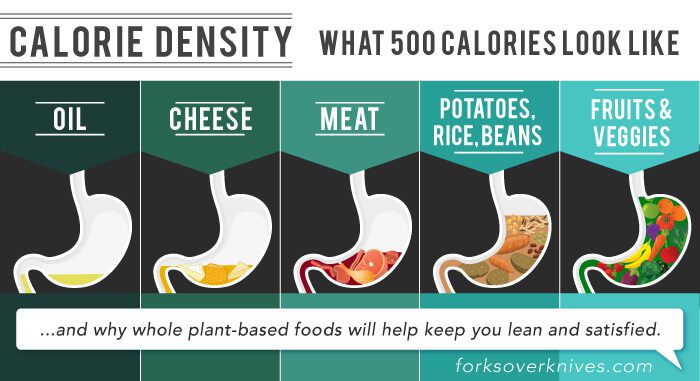
Calories from oil are insidious for several reasons:
1) they are the most concentrated calories we consume.
2) Oils have either very little or no taste. Compare for example the taste of any oil to a ripe peach. One taste is "huh?" and the other is "wow!" Even olive oil, which has a bit of residual flavor, is relatively tasteless. Compare olive oil to an olive. That's what I'm talking about...we don't even know they are in our foods because we can't taste them, they are so "hidden" we can't detect them. Sugars at least we can detect, we know they are there, helping us to avoid that particular category of (empty) calories.
3) And yet, even though they have no taste, we are "attracted" to them. How does that work? We are "hard wired" to be attracted to concentrated calories. Why? Ever notice animals in nature tend to be lean? Calories are scarce in nature, all animals (us included) are instinctively attracted to denser calorie sources. You think we humans have "lost" our instincts? Next time you step on the scale think about that again.
Instincts, BTW, are not bad, they are the reason we survive at all! But it helps to realize in this environment of food from factories the critical importance of understanding instinct, and how we are "driven" by it. ("The Pleasure Trap" explains the problem and solution to this modern conundrum beautifully.)
One can consume a diet chock-a-block full of hidden calories and still be a lean person...if, that is, you are one of those people who "live" in a gym, or run 10 miles a day, or...you get the picture. Ever notice what happens to those people when they stop burning so many more calories than the rest of us? Yep. Burp.
People who eat lean stay lean no matter what. It is "the secret" (but it's not really a secret is it?). The point of the title of this blog is being lean is not a matter of "work" it is a matter of choice.
So how do we protect ourselves from invisible calories? Start by becoming more aware of what's hiding in your foods. And recognize that culturally, collectively, we are clueless (doesn't mean we have to be individually!), and restaurants are dangerous places where we have to pick and choose carefully from amongst landmine menu choices.
In addition we want to eat whole foods as close to their natural state as possible. That kicks out that other refined substance we see everywhere, flour.
But for this blog we're going to focus on where the calories are highest and the most hidden of all, which is oils. On a volume basis they are the most calorie dense substance we consume, by far. Seen this?
Calories from oil are insidious for several reasons:
1) they are the most concentrated calories we consume.
2) Oils have either very little or no taste. Compare for example the taste of any oil to a ripe peach. One taste is "huh?" and the other is "wow!" Even olive oil, which has a bit of residual flavor, is relatively tasteless. Compare olive oil to an olive. That's what I'm talking about...we don't even know they are in our foods because we can't taste them, they are so "hidden" we can't detect them. Sugars at least we can detect, we know they are there, helping us to avoid that particular category of (empty) calories.
3) And yet, even though they have no taste, we are "attracted" to them. How does that work? We are "hard wired" to be attracted to concentrated calories. Why? Ever notice animals in nature tend to be lean? Calories are scarce in nature, all animals (us included) are instinctively attracted to denser calorie sources. You think we humans have "lost" our instincts? Next time you step on the scale think about that again.
Instincts, BTW, are not bad, they are the reason we survive at all! But it helps to realize in this environment of food from factories the critical importance of understanding instinct, and how we are "driven" by it. ("The Pleasure Trap" explains the problem and solution to this modern conundrum beautifully.)
People who eat lean stay lean no matter what. It is "the secret" (but it's not really a secret is it?). The point of the title of this blog is being lean is not a matter of "work" it is a matter of choice.
So how do we protect ourselves from invisible calories? Start by becoming more aware of what's hiding in your foods. And recognize that culturally, collectively, we are clueless (doesn't mean we have to be individually!), and restaurants are dangerous places where we have to pick and choose carefully from amongst landmine menu choices.
Tuesday, April 17, 2018
Whole Foods Practitioners Discussing Supplementation
You may find this interesting - a panel of working health practitioners with a whole foods bias discussing pros and cons of supplementation at a whole foods based health conference.
Brian and Anna Maria Clement of Hippocrates Institute, Pam Popper ND, Julieanna Hever RD, and Garth Davis MD share perspectives.
Brian and Anna Maria Clement of Hippocrates Institute, Pam Popper ND, Julieanna Hever RD, and Garth Davis MD share perspectives.
Thursday, April 5, 2018
Rich Roll, "Rejecting Middle Age"
Rich Roll's book "Finding Ultra: Rejecting Middle Age, Becoming One of the World's Fittest Men, and Discovering Myself" was a huge inspiration for me as I set out to reverse symptoms of heart disease some eight years ago. So many aspects of it spoke to me.
https://www.amazon.com/Finding-Ultra-Revised-Updated-Discovering/dp/0307952207/ref=tmm_pap_swatch_0?_encoding=UTF8&qid=&sr=
Here's Rich in a recent video interview
https://www.amazon.com/Finding-Ultra-Revised-Updated-Discovering/dp/0307952207/ref=tmm_pap_swatch_0?_encoding=UTF8&qid=&sr=
Here's Rich in a recent video interview
Subscribe to:
Posts (Atom)