Friday, April 27, 2018

Would you rather be automatically fat (without trying) or automatically lean (without trying)?

The key is to get the "invisible" calories out of your diet. What I call "invisible calories" are the refined substances added to pretty much every recipe you see these days, and certainly every meal you have at a restaurant. And yep we're talking mostly concentrated carbohydrates (table sugar) and concentrated fats (vegetable oils).

In addition we want to eat whole foods as close to their natural state as possible. That kicks out that other refined substance we see everywhere, flour.

But for this blog we're going to focus on where the calories are highest and the most hidden of all, which is oils. On a volume basis they are the most calorie dense substance we consume, by far. Seen this?
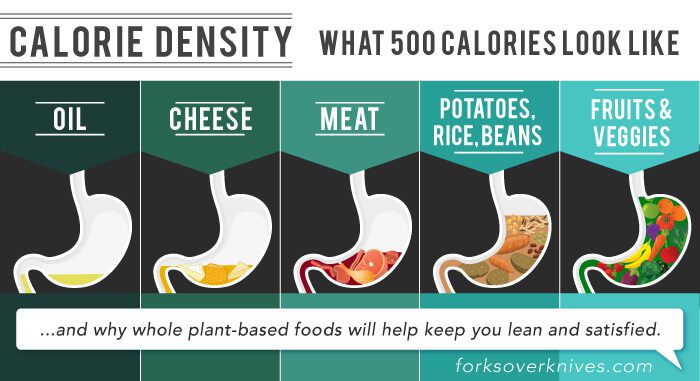
Image result for how many calories take up the stomach

Calories from oil are insidious for several reasons:

1) they are the most concentrated calories we consume.

2) Oils have either very little or no taste. Compare for example the taste of any oil to a ripe peach. One taste is "huh?" and the other is "wow!" Even olive oil, which has a bit of residual flavor, is relatively tasteless. Compare olive oil to an olive. That's what I'm talking about...we don't even know they are in our foods because we can't taste them, they are so "hidden" we can't detect them. Sugars at least we can detect, we know they are there, helping us to avoid that particular category of (empty) calories.

3) And yet, even though they have no taste, we are "attracted" to them. How does that work? We are "hard wired" to be attracted to concentrated calories. Why? Ever notice animals in nature tend to be lean? Calories are scarce in nature, all animals (us included) are instinctively attracted to denser calorie sources. You think we humans have "lost" our instincts? Next time you step on the scale think about that again.

Instincts, BTW, are not bad, they are the reason we survive at all! But it helps to realize in this environment of food from factories the critical importance of understanding instinct, and how we are "driven" by it. ("The Pleasure Trap" explains the problem and solution to this modern conundrum beautifully.)

One can consume a diet chock-a-block full of hidden calories and still be a lean person...if, that is, you are one of those people who "live" in a gym, or run 10 miles a day, or...you get the picture. Ever notice what happens to those people when they stop burning so many more calories than the rest of us? Yep. Burp.

People who eat lean stay lean no matter what. It is "the secret" (but it's not really a secret is it?). The point of the title of this blog is being lean is not a matter of "work" it is a matter of choice.

So how do we protect ourselves from invisible calories? Start by becoming more aware of what's hiding in your foods. And recognize that culturally, collectively, we are clueless (doesn't mean we have to be individually!), and restaurants are dangerous places where we have to pick and choose carefully from amongst landmine menu choices.

Tuesday, April 17, 2018

Whole Foods Practitioners Discussing Supplementation

You may find this interesting - a panel of working health practitioners with a whole foods bias discussing pros and cons of supplementation at a whole foods based health conference.

Brian and Anna Maria Clement of Hippocrates Institute, Pam Popper ND, Julieanna Hever RD, and Garth Davis MD share perspectives.


Thursday, April 5, 2018

Rich Roll, "Rejecting Middle Age"

Rich Roll's book "Finding Ultra: Rejecting Middle Age, Becoming One of the World's Fittest Men, and Discovering Myself" was a huge inspiration for me as I set out to reverse symptoms of heart disease some eight years ago. So many aspects of it spoke to me.

https://www.amazon.com/Finding-Ultra-Revised-Updated-Discovering/dp/0307952207/ref=tmm_pap_swatch_0?_encoding=UTF8&qid=&sr=

Here's Rich in a recent video interview


Saturday, March 31, 2018

The Big Debate: Are Carbs or Fats Our Primary Fuel?

We know a few things for sure - no debate on certain critical points:

1) Both work more optimally as fuel sources when they are not mixed to any great degree in the same diet.

2) Both keto and high carb dieters report increased well being and reversal of certain diseases.

So the answer to the question which is best comes down to just that, which is best, and there are several measures that can apply:

1) Sustainability
     a. emotional - which is easier to stick with? Are we instinctually more attracted to high fat or high carb foods?
     b. nutritional - is either more likely to crash for physiologic reasons?
     c. does either introduce higher levels of toxicity?
     d. is conversion of food to fuel more efficient with either? (Ratio of calories burned to get fuel calories).

2) Longevity - does either support longer disease free life?

3) Freedom from discomfort - which feels better day to day? (Optimal health is "invisible", we are not aware of physiologic functioning until there is a problem.)
     a. Digestion is a critical function - is it "invisible"?
     b. Sleep is a critical function - is it easy and good?

4) Freedom from common diseases - are colds and allergies less likely on either?

5) When used for disease reversal
     a. which is more efficient in terms of rapidity?
     b. in terms of degree of reversal?

6) Cognitive performance - is either better?

7) Athletic performance - is either better?

8) Recovery from stressors
     a. emotional - are psychological markers better on either?
     b. physical - do high level athletes recover more quickly on either?

From everything I have seen to this point, the weight of scientific evidence (controlled trials and long term population studies) is clearly on the side of high carb. It would be interesting (but time consuming) to organize the evidence that does exist on a point by point basis.

My own anecdotal experience, what I have seen among the paleo dieters vs the high carb dieters I have had personal contact with, also leans clearly toward high carb.

The question itself, which is better, seems to have only come into clear focus recently, and further study of the specifics would clearly be helpful. Impediments to that process may be (or continue to be) the industries whose interests might be damaged by further study, including meat and dairy, pharmacology and medicine, processed food, and health care insurance.

Any of these questions could be the topic for a single blog post. I may attempt some of that going forward, meanwhile I'll let them hopefully serve simply as food for thought.

Friday, March 30, 2018

Does our physiology prefer fat or sugar as it's primary source of energy?

Interesting question, hotly debated these days.

We know healthy blood sugar level falls into a relatively narrow invariant range (becoming "Paleo" doesn't change it).

We know dietary sugar in the blood does not interfere with the delivery of fat from the blood to the cells, but dietary fat in the blood dramatically interferes with the delivery of sugar from the blood to the cells.

We also know the body has two immediate invariant needs for "fuel", oxygen and sugar. A very short time without either and we're dead.

As blood sugar drops below normal range we begin to get into trouble...initially basic functioning becomes difficult, if they continue to drop we lose consciousness, and if it drops further death will result:

https://www.quora.com/What-would-happen-if-your-blood-sugar-is-zero

Blood lipid levels are typically associated with levels of cholesterol, the building block fat, where according to this article there are no immediate pronounced effects to low levels, and long term effects are as yet not all that clear:

https://onlinelibrary.wiley.com/doi/pdf/10.1002/lite.201000070

Serum triglycerides are the fats burned as energy, this article says among other things there are no particular day to day symptoms associated with either high or low levels of triglycerides.

https://www.belmarrahealth.com/low-triglycerides-causes-symptoms/

Wednesday, March 28, 2018

Why didn't anyone tell me this, pt 2

In the previous post video Cyrus and Robbie say they can demonstrate over and over that a whole food plant based diet reverses diabetes quickly and efficiently. They also feel this diet is the healthiest long term diet possible for humans, and is essentially the same diet detailed in the book "The Blue Zones of Happiness: Lessons From the World's Happiest People"

https://www.amazon.com/Blue-Zones-Happiness-Lessons-Happiest/dp/1426218486/ref=tmm_hrd_swatch_0?_encoding=UTF8&qid=1522244209&sr=1-1

But if this is true, and it becomes clear and obvious when applied by real people, why haven't we heard more about this so-called science? Where is it?

The science is there, and voluminous. What we tend to hear about and see however is "conflict science" (like conflict diamonds), which is what makes it into popular media reports.

Can we just call a spade a spade, and say "big science" (fueled by the big money of big ag, big pharma, big food, big health care, and big insurance) has worked tirelessly to obscure the authentic science on the pivotally critical role of diet in health?

Authentic science also shows funding for studies heavily influences conclusions. And this problem is compounded by our culturally induced eagerness to believe the best about our bad habits.

What's a person to do? Well, perhaps begin by taking "the latest science" with a grain of salt. And then, if so motivated, look for what works, and then compare how well it works relative to other approaches that produce better health.

Robbie and Cyrus have put together a plant based health education initiative called "Mastering Diabetes" which is currently presenting an excellent online "symposium" featuring some of the best thought leaders, scientists, doctors and medical professionals in the plant based health movement, free to watch for another several days as of this writing 3/30/18 (and after which it goes behind a paywall), and well worth the investment of time!

I just watched the David Katz MD presentation, which I recommend very highly. The work Dr Katz is doing gives me hope we may be closer to "universal" reversal of the chronic disease epidemic than I thought.

https://masteringdiabetes.teachable.com/

Tuesday, March 27, 2018

Why didn't anyone TELL me this?


Like...maybe my doctor?

Everyone deserves to know the truth about insulin resistance, the precursor condition not only to type 2 diabetes, but also the atherosclerotic family of diseases and the autoimmune family of diseases.

Here ya go:


The page at the link below might give some clue as to exactly why we've been "left in the dark" (and continue to be), and it's only the tip of a (much) larger iceberg that also includes medications for the atherosclerotic family of diseases and the autoimmune family of diseases - high blood pressure and rheumatoid arthritis meds each generate more revenue than diabetes meds.

Not to mention cancer, which also implicates "bad diet" as a significant causal factor in current epidemic levels in developed world populations.

10 highest selling diabetes drugs 2016:


The total comes to 17.294 billion. This figure represents US only, 2016 only, for the top selling diabetes meds only.

Now start multiplying.

https://www.fiercepharma.com/special-report/top-10-diabetes-drugs-by-2016-sales